At a Glance — Side-by-Side Summary
| Feature | IPM (IIM 5-year) | Regular BBA (3-year) |
|---|---|---|
| Duration | 5 years (BBA + MBA) | 3 years (BBA only) |
| Final degree | UG + MBA from an IIM | Bachelor's degree only |
| Institution | IIMs (Indore, Rohtak, etc.) | Any university/college |
| Need CAT for MBA? | No — auto-progression | Yes, after graduation |
| Placements | With the IIM MBA batch | Depends on college |
| Commitment | High (locked in at 17–18) | Flexible |
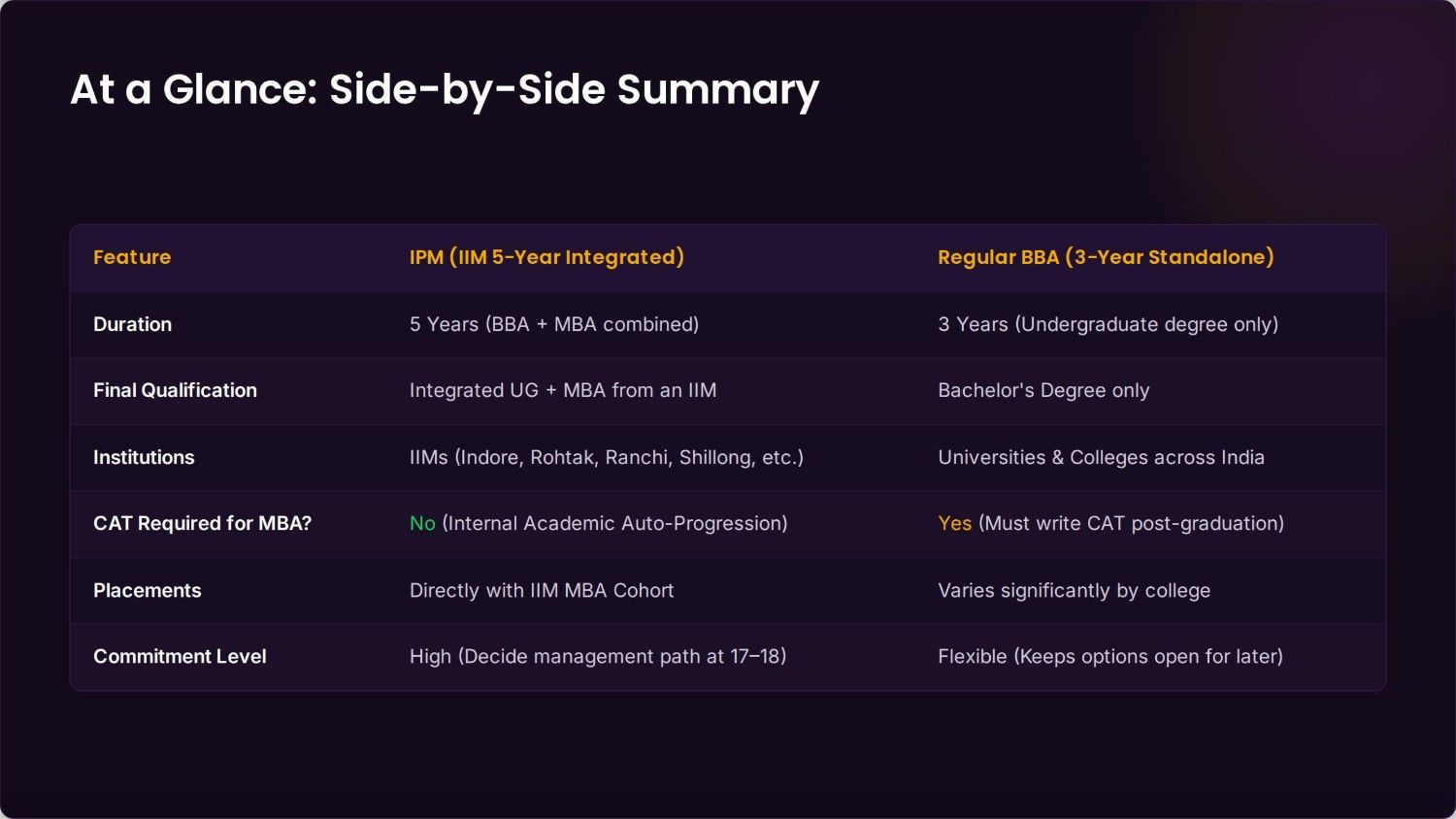
Table of Contents
- What is IPM?
- What is a regular BBA?
- The degree difference
- The CAT difference
- Placements & brand
- Cost & commitment
- Which should you choose?
- FAQs
What is IPM?
The Integrated Programme in Management (IPM) is a five-year dual-degree course at an IIM — three years of undergraduate management followed by two years of MBA-level study — taken directly after Class 12. Launched by IIM Indore in 2011, it is now offered by seven IIMs including Indore, Rohtak, Ranchi, Shillong, Jammu, Bodh Gaya and Amritsar.
You finish with both an undergraduate degree and a postgraduate management qualification from an IIM, in one continuous, on-campus programme. Admission is through IPMAT or JIPMAT — an aptitude test, not CAT.
What is a Regular BBA?
A regular Bachelor of Business Administration is a standalone three-year undergraduate degree offered by hundreds of universities and colleges across India. It gives you business fundamentals and, on graduation, you either enter the job market or pursue a separate MBA — which usually means writing CAT or another entrance exam.
BBA is flexible and widely accessible, but it is an undergraduate qualification on its own. The MBA — the degree that most shapes a management career — is a separate journey you arrange later.
Future IIMer tip: The core question isn't "BBA or IPM?" — both start with a bachelor's. It's whether you want your MBA and your IIM brand locked in now, or kept open for later.
The Degree Difference
This is the heart of the comparison. A regular BBA leaves you with one undergraduate degree after three years. IPM leaves you with an integrated UG + MBA from an IIM after five. You are effectively committing to your postgraduate degree at 17–18 instead of deciding at 20–21.
For a student certain about a management career, that is a huge head start. For one still exploring, the standalone BBA keeps every door open.
Exploring IPM 2027? Get IPM Careers' free study plan and mentor review → ipmcareer.com
The CAT Difference
Here is IPM's single biggest structural advantage. After the first three years, IPM students are promoted directly into the MBA phase — no CAT required (subject to meeting the institute's internal academic criteria). At IIM Indore, IPM students merge with the regular MBA batch in the fourth and fifth years.
A regular BBA graduate who wants an IIM MBA must sit CAT — one of India's most competitive exams — and then clear group discussions and interviews, competing against lakhs of applicants. IPM lets you bypass that gauntlet entirely, provided you maintain your grades.
| Path | Route to MBA |
|---|---|
| IPM | Auto-progression after Year 3 (maintain CGPA) — no CAT |
| Regular BBA | Graduate, then crack CAT + WAT-PI for an IIM |
Placements & Brand
Because IPM students merge with the IIM MBA cohort, their placements happen through the same process as the MBA batch. That is a decisive edge: an IPM student is placed as an IIM MBA graduate, not as a BBA graduate.
At IIM Indore, the combined PGP + IPM batch (2023–25) recorded an average package of around ₹29.57 LPA with a median near ₹27 LPA and a top domestic offer of ₹70 LPA, with recruiters such as Deloitte, Accenture and HSBC.
A regular BBA's placements vary enormously by college and rarely match top-IIM MBA outcomes without a separate MBA on top. The IIM brand, faculty and network are baked into IPM from year one.
Cost & Commitment — The Honest Trade-off
IPM is not automatically the better choice for everyone. It asks for more.
- Commitment: Five years at one institute, a management path chosen at 17–18.
- Academic pressure: You must maintain the required CGPA to progress to the MBA phase — slipping can jeopardise auto-progression.
- Cost: IIM programme fees are higher than most standalone BBAs, though placements justify the investment for many.
A regular BBA is cheaper, shorter and more flexible — ideal if you're unsure about management, want to keep options like law, design or a foreign MBA open, or prefer to decide on postgraduate study later.
Honest read: IPM trades flexibility for a head start. If you're confident about management and can clear IPMAT, that trade is often worth it. If you're still exploring, flexibility has real value — don't dismiss the BBA.

Which Should You Choose? Decision Framework
| Choose IPM if… | Choose a regular BBA if… |
|---|---|
| You're sure about a management career | You're still exploring fields |
| You want an IIM MBA without later CAT | You want flexibility to switch paths |
| You can clear IPMAT/JIPMAT | You prefer a lower-cost, shorter degree |
| You want top-tier placements built in | You may study abroad or pivot later |
There is no universally superior option — only the better fit for your certainty, your budget and your appetite for a five-year commitment.
Frequently Asked Questions
Is IPM better than a regular BBA?
For a student certain about management, IPM offers a stronger package — an IIM MBA, no later CAT, and top-tier placements. A regular BBA is better if you want flexibility, lower cost, or the freedom to decide on an MBA later. Neither is universally "better".
Do IPM students have to write CAT?
No. IPM students are promoted directly to the MBA phase after three years, provided they meet the institute's academic criteria. This is IPM's biggest advantage over the BBA-then-CAT route.
Are IPM placements the same as IIM MBA placements?
Largely yes. At IIMs like Indore, IPM students merge with the MBA batch for the final years and are placed through the same process, so their outcomes track the MBA cohort.
Is IPM more expensive than a BBA?
Generally yes — IIM programme fees exceed most standalone BBAs. However, the integrated MBA and IIM-level placements often justify the cost for management-focused students.
Can I do an MBA after a regular BBA instead?
Absolutely. A BBA graduate can pursue an MBA by cracking CAT or another entrance exam. The trade-off is time and the competitiveness of CAT — which IPM lets you skip.
Conclusion
The real difference between IPM and a regular BBA isn't the first three years — both start with a bachelor's. It's what comes attached: IPM bundles an IIM MBA, skips CAT and plugs you into top placements, in exchange for a five-year commitment made early. A regular BBA keeps everything flexible and affordable, but leaves the MBA — and the IIM brand — as a separate battle for later. Match the path to your certainty, and if IPM is your goal, start IPMAT preparation early.
Ready to target IPM 2027? Explore IPM Careers' courses → ipmcareer.com/courses