For years, students dreaming of a management degree straight out of school have had to navigate a maze of entrance exams — IPMAT, JIPMAT, JEE, CUET, and institute-specific tests — each with its own syllabus, pattern, and deadline. That maze could soon get a lot simpler. According to official documents accessed by Hindustan Times through an RTI application, the Indian Institutes of Management (IIMs) are actively discussing a common entrance test for undergraduate (UG) and Integrated Programme in Management (IPM) courses, along with a centralised MBA counselling platform, a standardised fee-refund policy, and a framework for inter-IIM student transfers.
These proposals emerged from the Coordination Forum of IIMs, chaired by then Union Education Minister Dharmendra Pradhan, at a meeting held in Ahmedabad on May 14, 2026. The minutes were circulated to IIMs by the education ministry on June 17 and made public via RTI on September 15. While the forum is only an "advisory body" under the IIM Act, 2017 — unlike the IIT Council, whose decisions bind IITs — the discussions signal a clear direction of travel for the IIM system, and every UG and MBA aspirant should be paying attention.
Why a Common Entrance Test Is Even on the Table
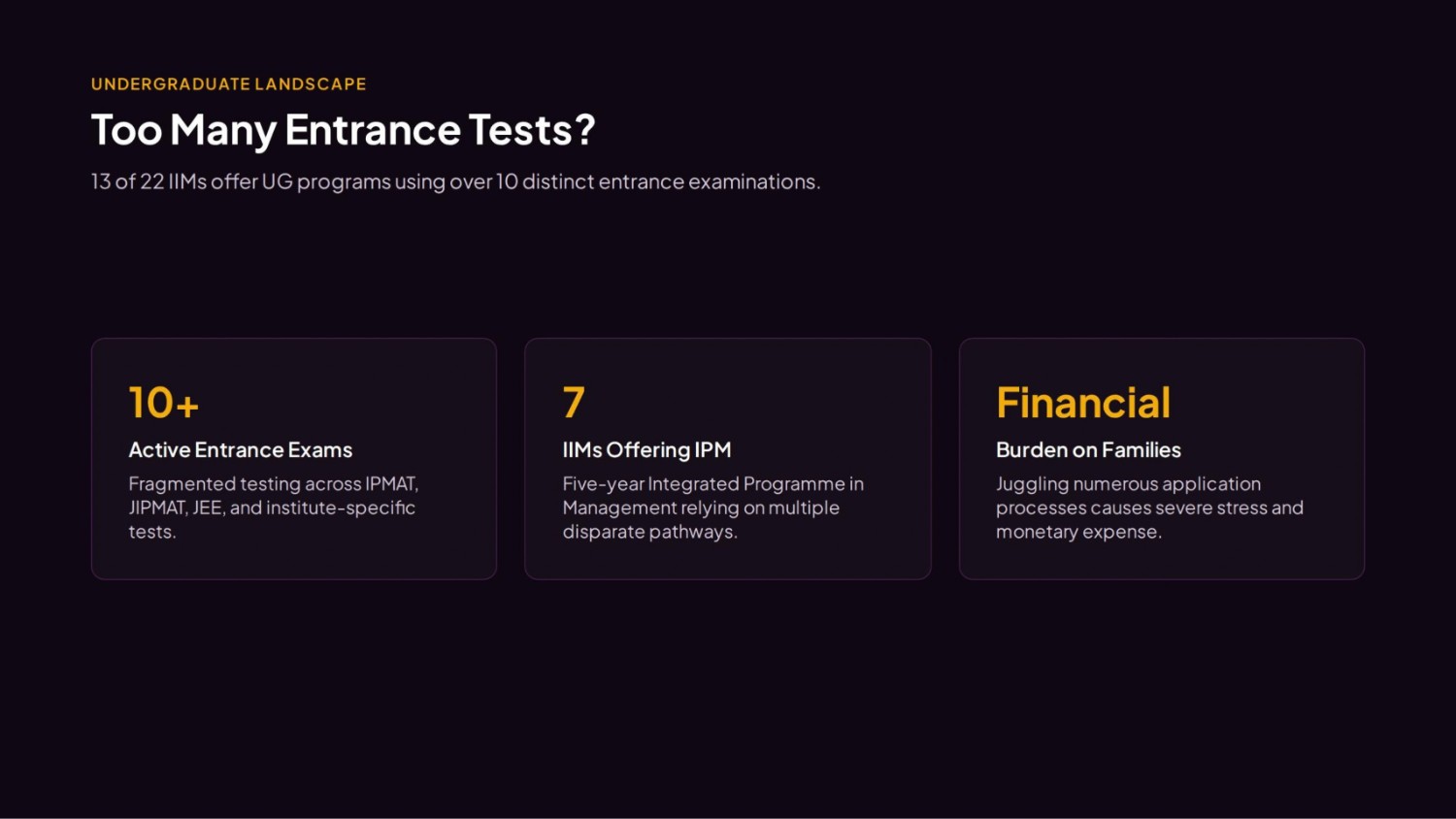
Right now, 13 of the 22 IIMs offer UG programmes, and the entry routes are anything but uniform. Seven IIMs — Indore, Rohtak, Ranchi, Jammu, Bodh Gaya, Amritsar, and Shillong — run five-year IPMs using three different admission mechanisms: IPMAT, JIPMAT, and IIM Rohtak's own aptitude test. Add to this the newer four-year programmes, and the picture gets even more fragmented. IIM Lucknow's BS in AI & Business Analytics relies on JEE Advanced, IIM Mumbai's BS in Digital Science and Business Management uses JEE Main, IIM Sambalpur and Sirmaur use IPMAT, IIM Kozhikode has its own BMS Aptitude Test, IIM Bangalore runs the IIMB Undergraduate Admissions Test, and IIM Udaipur admits BBA students without any entrance exam at all.
At the meeting, Dharmendra Pradhan reportedly said multiple UG entrance tests should be "avoided," while carefully framing this not as government overreach but as a natural extension of the government's role as a stakeholder in higher education. It's a diplomatic way of nudging a historically autonomous system toward consolidation.
A House Divided: Where the IIMs Stand
Unsurprisingly, not every IIM agrees on the way forward.
IIM Indore, the pioneer of the IPM format since 2011, defended the status quo, arguing that multiple tests give students "multiple opportunities" and cater to different programme needs — even while admitting that running separate application and admission processes is a financial burden for institutes and families alike. Its proposed middle ground: let any IIM planning to launch an IPM simply plug into the existing IPMAT framework, an idea backed by IIM Rohtak.
IIM Bodh Gaya, Jammu, Amritsar, and Ranchi were more open to a single common test, with Jammu and Bodh Gaya going a step further and suggesting it be conducted by the National Testing Agency (NTA) — the same body that runs JEE, NEET, and CUET.
IIM Kozhikode pushed back in the opposite direction, favouring "minimal regulation" so individual institutes retain flexibility over their own admission criteria.
IIM Udaipur offered perhaps the most pragmatic suggestion: skip creating a brand-new exam altogether and simply use scores from JEE, CUET, or CLAT — tests millions of students are already taking.
IIM Lucknow director MP Gupta explained the rationale behind exam-specific admissions this way: "Our UG program requires students with a strong mathematical background. We admit students through JEE Advanced because it aligns with the academic requirements of the programme." IIM Indore director Himanshu Rai summed up the emerging middle ground: "The broader consensus idea was to avoid creating new entrance tests and instead leverage credible examinations that already exist."
For now, though, no decision has been finalised. Then Higher Education Secretary Vineet Joshi cautioned that a change of this scale needs deeper analysis of students' test-taking patterns and socio-economic backgrounds before any single meeting can settle it.
A JoSAA-Style Counselling System for MBA Admissions
Perhaps the most consequential — and least discussed — proposal on the table is a common counselling platform for MBA admissions, modelled directly on the Joint Seat Allocation Authority (JoSAA) system used by IITs and NITs. Currently, candidates often pay non-refundable seat-booking amounts at multiple IIMs simultaneously while they decide, which locks up seats and causes real financial loss for students who eventually choose a different institute.
The proposed fix: a digital platform where candidates could freeze, slide, or float their choices across IIMs, much like engineering aspirants do today. IIM Mumbai has already been tasked with building a prototype and, according to a senior official at the institute, it was submitted to the education ministry by the end of July 2026. The ministry's review and a final decision are still pending.
Reactions here, too, are mixed. IIM Lucknow's Gupta called it "a good" idea, but IIM Indore's Rai flagged a structural difference between IIMs and engineering colleges: "Unlike engineering institutions, IIMs have different missions, pedagogies and admission processes." He pointed to a real pain point for newer IIMs — seats going vacant when students accept offers from older, more established institutes and simply walk away. One proposed fix is for older IIMs to close admissions by a fixed date and share data with newer ones, so waitlists can be managed more efficiently across the system.
Fixing the Fee-Refund Mess
The third major thread of discussion was fee refunds — an issue that has generated real student grievances. Some IIMs refuse refunds if a student withdraws before classes begin, citing potential shortfalls in batch size. Others penalise students who migrate to a different IIM after admission.
While most IIMs broadly follow a UGC-modelled policy — refunding the admission confirmation amount minus a ₹1,000 deduction for pre-commencement withdrawals — several institutes deviate sharply:
- IIM Udaipur allows withdrawal after classes begin, but deducts ₹30,000
- IIM Visakhapatnam bars refunds entirely once Term-I starts
- IIM Mumbai prescribes forfeiture of the admission amount in certain cases
- IIM Calcutta states, for some programmes, that fees paid are "not refundable under any circumstances"
The forum has called for a standardised, UGC-aligned refund policy to be rolled out from the 2026–27 academic year, and the forum's chairman has directed the formation of a sub-committee to work out both the refund policy and a formal Standard Operating Procedure for inter-IIM student migration — with the explicit goal of minimising the financial burden on students.
What This Means for You
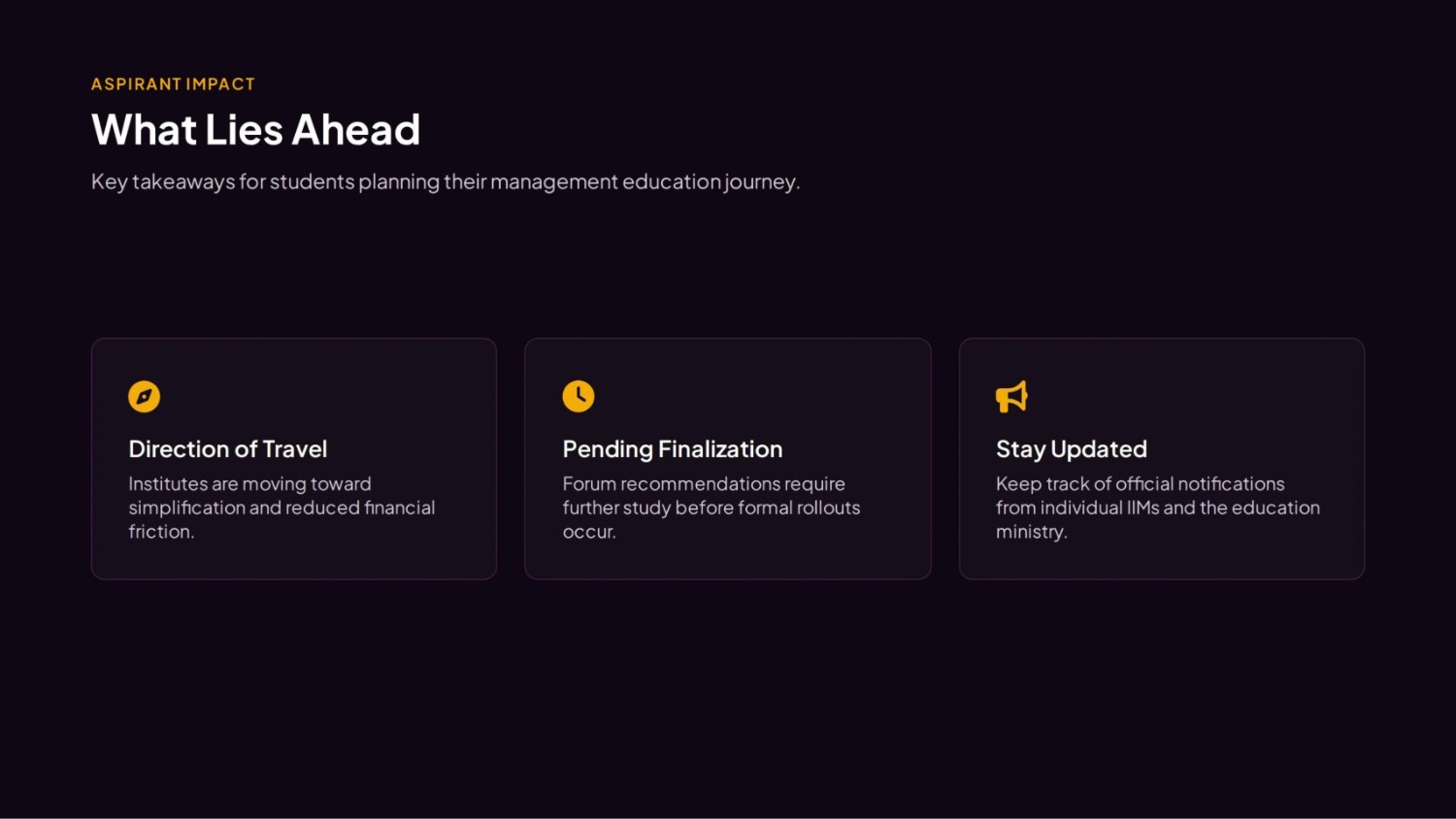
If you're preparing for IPMAT, JIPMAT, or any UG management entrance exam, don't expect an overnight overhaul — these are still discussions at an advisory forum, not binding directives. But the direction is unmistakable: greater standardisation of UG admissions, a more transparent and JoSAA-like counselling process for MBA seats, and fairer, more predictable fee-refund rules across the IIM system.
For current aspirants, the smartest strategy remains the same: prepare thoroughly for the specific test(s) relevant to your target IIMs today, while keeping an eye on official IIM and education ministry notifications for any confirmed changes to the admission process in the coming academic cycles. Bookmark this space — we'll keep you updated as these proposals move from meeting minutes to actual policy.
This article is based on official Coordination Forum of IIMs meeting minutes obtained by Hindustan Times via an RTI application.